Varicose Veins vs Spider Veins
Varicose Veins vs Spider Veins: What’s Actually Different
You’re standing in front of the mirror, looking at a web of thin red or purple lines on your thigh, and wondering: is this a varicose vein? Should you be worried?
Then a week later, your aunt shows you the thick, rope-like vein bulging on her calf and calls it the same thing.
They’re not the same thing, and knowing the difference actually matters, because the treatment for one isn’t always the treatment for the other. If you’ve already noticed pain or heaviness along with the visible veins, it’s worth checking our full breakdown of varicose veins symptoms as well.
The Quick Answer
Both varicose veins and spider veins come from the same root problem: weakened vein valves that let blood pool instead of flowing properly back to the heart. The difference is in size, depth, and how serious they usually are.
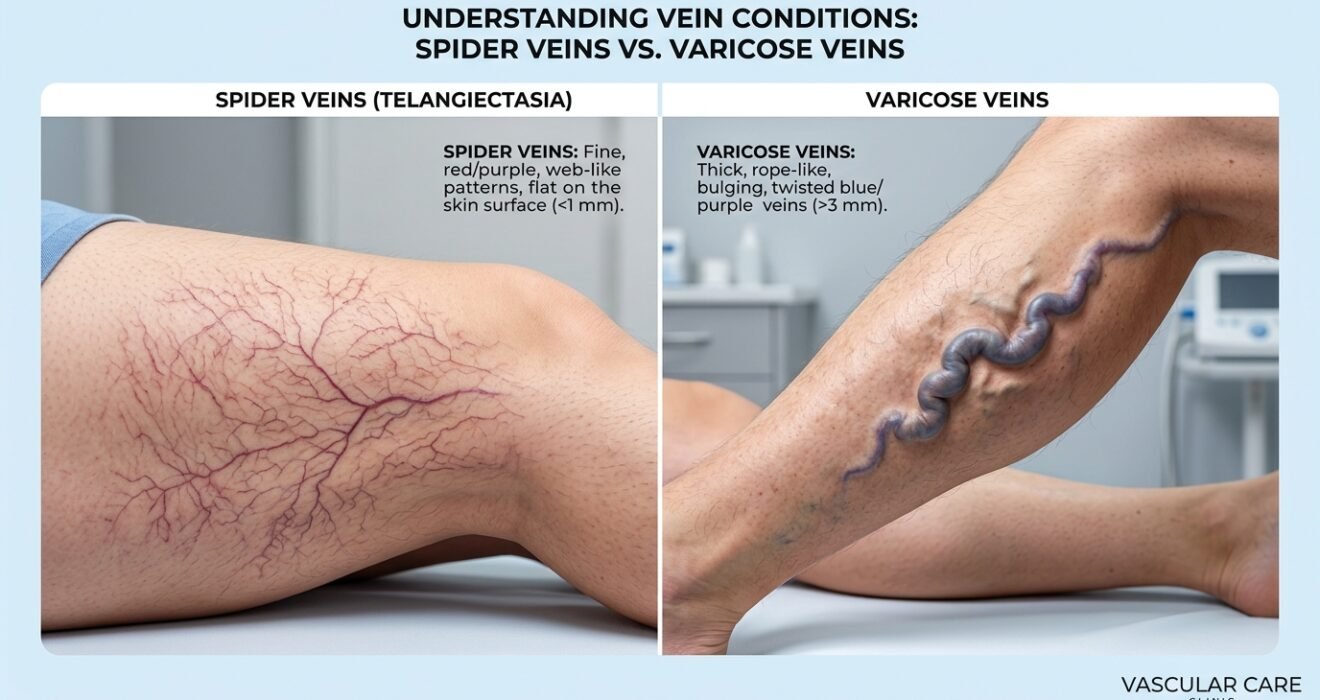
- Varicose veins are large, twisted, and raised. You can usually see and often feel them bulging under the skin.
- Spider veins are small, thin, and flat. They look like a web or a tree branch pattern, usually red, blue, or purple.
Think of it this way: varicose veins are a structural vein problem you can physically feel, while spider veins are mostly a surface-level cosmetic pattern.
How to Tell Which One You Have
Here’s a simple way to check, without needing a medical degree.
Look at the size
Spider veins are typically a millimeter or less in width. Varicose veins are noticeably thicker, sometimes as wide as a pencil.
Check if it bulges
Run your finger over the area. Varicose veins usually stick out slightly above the skin’s surface. Spider veins stay completely flat.
Notice the color pattern
Spider veins tend to branch out in a web-like or tree-like shape. Varicose veins look more like a single twisted cord or rope.
Pay attention to symptoms
Varicose veins often come with aching, heaviness, or throbbing, especially after standing for a while. Spider veins are usually painless.
If you’re still not sure after checking these, that uncertainty alone is a good reason to get it looked at properly rather than guessing.
Do They Show Up in the Same Places?
Mostly, but not always. Varicose veins almost always appear on the legs, since that’s where vein pressure is highest due to standing and walking. Spider veins also commonly show up on the legs, but they can appear on the face too, particularly around the nose and cheeks.
If you’re seeing spider vein-like patterns on your face, that’s usually unrelated to leg vein disease and often linked to sun exposure or skin sensitivity instead.
Are Spider Veins a Warning Sign of Varicose Veins?
Sometimes, yes. Spider veins can appear on their own, unrelated to any deeper issue. But they can also be an early sign of the same weak-valve vein problem that eventually leads to varicose veins, especially if they show up in clusters around the ankle or inner thigh.
This is exactly why understanding what causes varicose veins in the first place is useful even if all you currently have are spider veins. Catching the underlying issue early can prevent it from progressing.
Which One Actually Needs Treatment?
This is where people often overthink it. Neither condition is dangerous by default. Most cases of both varicose veins and spider veins are treated for comfort or appearance rather than because of a medical emergency.
That said, here’s the general difference:
Spider veins are almost always a cosmetic concern. Treatment, when someone chooses it, is usually about appearance rather than symptom relief since they rarely cause pain.
Varicose veins can be cosmetic too, but they’re more likely to cause actual physical discomfort, and in some cases, complications like skin changes or ulcers if left untreated long-term. If you’re noticing pain, swelling, or skin discoloration, that’s worth a proper look rather than home remedies alone. Our guide on varicose veins warning signs covers exactly which symptoms shouldn’t be ignored.
Treatment Differences
Because the veins are different sizes, the treatment approach differs too.
Spider veins are typically treated with sclerotherapy, a simple injection that closes off the small vein, or sometimes laser treatment.
Varicose veins need a more targeted approach since the vein is larger and deeper. This is where techniques like TEVLA laser ablation come in, closing the faulty vein and redirecting blood flow to healthier ones nearby. In advanced cases, surgical removal may be recommended instead.
Mayo Clinic notes that spider veins are simply a milder form of the same vein condition as varicose veins. Cleveland Clinic adds that spider veins technically aren’t even veins, they’re damaged capillaries, while true varicose veins are larger veins carrying blood back to the heart. The NHS confirms spider veins are generally harmless on their own, unlike varicose veins, which can occasionally lead to complications if left untreated.
Can You Have Both at the Same Time?
Yes, and it’s actually quite common. Someone might have a large varicose vein on the back of the knee and a cluster of spider veins near the ankle on the same leg. Both are usually connected to the same weakened valve system, just showing up at different points along the vein.
What Should You Actually Do Next?
If it’s small, flat, and doesn’t hurt, it’s probably a spider vein. No rush, get it treated later if it bothers you.
If it’s raised, thick, or aching, it’s probably a real varicose vein. Better to get it checked than wait and hope it fades, because it usually doesn’t.
Either way, a quick check-up (sometimes with an ultrasound) will tell you for sure. Want a clear answer instead of guessing? Book a consultation here.