Laser Treatment vs Surgery for Varicose Veins: What Every Patient Should Know Before Deciding
Laser Treatment vs Surgery for Varicose Veins
If a doctor has told you that your varicose veins need treatment, you’ve probably been handed two words: surgery or laser. And if you’re like most patients, those two words raised more questions than they answered.
raised more questions than they answered.
Which one works better? Which one hurts less? Which one will actually last? And—perhaps most practically—what does it cost in Pakistan?
These are fair questions. And you deserve honest, clear answers — not a sales pitch and not a wall of medical jargon that sends you back to Google.
This guide walks you through both options, explains exactly why the standard of care has shifted, and tells you what to look for when choosing where to get treated.
The best varicose vein treatment isn’t always the most dramatic one. It’s the one designed precisely for your anatomy—and performed by someone who knows the difference.
The traditional path: what was vein stripping surgery—and why it’s fading
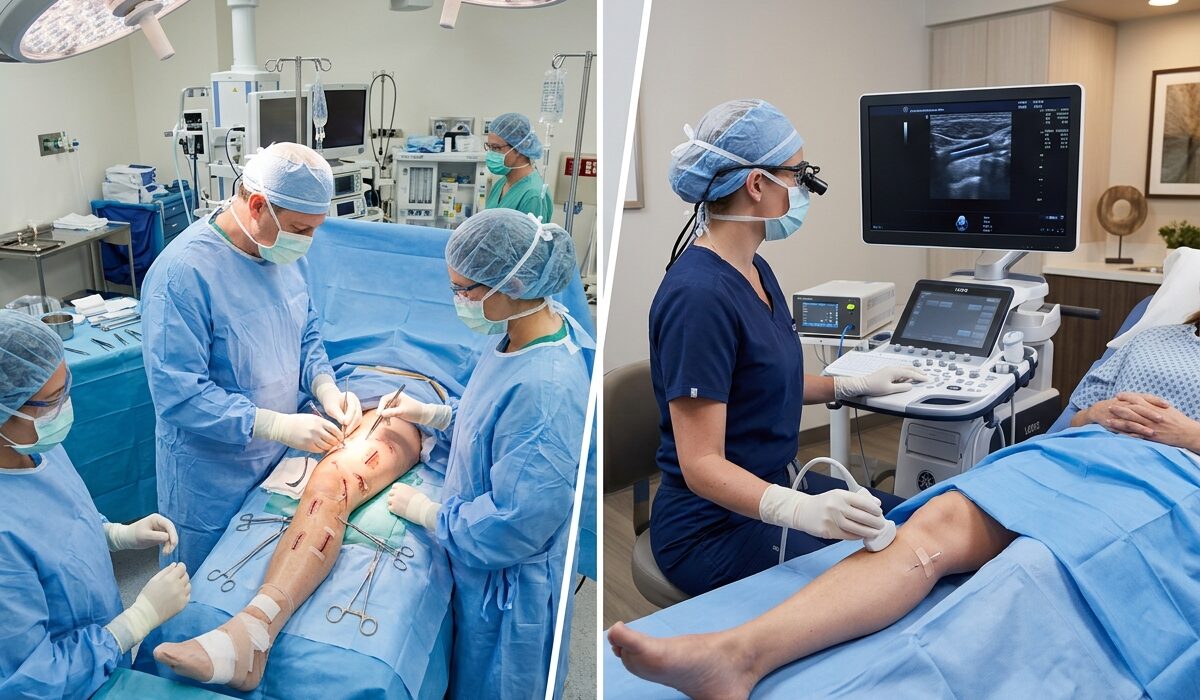
For most of the 20th century, varicose vein surgery meant one thing: vein stripping. A surgeon made incisions at the groin and ankle, inserted a thin wire through the affected vein, and physically pulled it out of the leg.
It worked. But the experience for patients was significant.
General anesthesia. A hospital stay. Weeks of recovery at home. Bruising that could last a month. A real risk of nerve damage along the stripped vein tract. Scarring at every incision point.
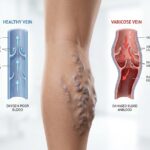
And then—for some patients—the veins came back. Because stripping removes the visible vein but doesn’t always address the underlying reflux driving it.
The modern standard: Total EVLA — endovenous laser ablation explained simply
Endovenous laser ablation—EVLA—is now the recommended first-line treatment for suitable varicose veins across leading vascular guidelines worldwide. In Lahore and across Pakistan, it is increasingly available at specialist centers equipped with the right technology.
Ultrasound mapping
Before anything begins, a duplex ultrasound maps the exact path of the diseased vein—identifying where the reflux starts and how far it extends. This is not optional. It’s what separates precise treatment from guesswork.
Local anaesthesia + tumescent fluid
A numbing solution is injected along the vein under ultrasound guidance. This protects surrounding tissue and keeps you completely comfortable throughout. No general anesthetic. No theater. No overnight stay.
Laser fibre insertion
A thin laser fiber is passed through a single needle entry point into the vein. Guided by live ultrasound, the fiber is positioned precisely at the source of the problem.
Controlled laser energy delivery
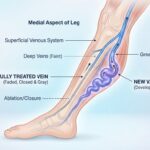
As the fiber is slowly withdrawn, it delivers calibrated laser energy that heats and seals the vein wall. The diseased vein closes. Blood is immediately rerouted through healthy veins nearby.
You walk out. That’s it.
The entire procedure takes 45–90 minutes. Patients walk out of the clinic the same day, compression stocking on, with instructions to stay active. Most return to normal activity within 24 to 48 hours.
The sealed vein is gradually absorbed by the body over the following weeks. The surface varicosities—the visible, twisted branches—typically shrink alongside it, though some may need a small additional procedure called foam sclerotherapy at the same or a follow-up session.
Step comfortably into the future—what life after EVLA looks like
Patients consistently say the same thing after EVLA: they wish they’d done it sooner.
Not because it’s painless—there’s usually some mild bruising and tightness along the treated vein for one to two weeks. But because the contrast with what they expected—based on stories of surgery—is so dramatic.
Walking out of a clinic in compression stockings, stopping for lunch on the way home, and returning to a desk job the next morning is genuinely what most EVLA patients experience. For those with physically demanding jobs, two to three days of lighter activity is typically enough.
What recovery actually looks like—week by week
Day 1–2: Walk regularly. Avoid prolonged sitting or standing. Mild tightness and bruising along the vein is normal.
Week 1–2: Continue daily walks. Wear compression stocking as advised. Most patients return to desk work within 24–48 hours.
Week 3–6: Surface veins continue to shrink and fade. A follow-up ultrasound confirms successful vein closure.
Month 3 onwards: Full activity including sport and travel. Annual follow-up is recommended to monitor for any tributary activity.
Experience Total EVLA: Book Your Walk-In, Walk-Out Treatment
Your legs deserve treatment designed around your unique anatomy, managed by verified clinical expertise. Stop living with constant heaviness, swelling, or the fear of surgical complications.
Take the modern path to recovery. Schedule a comprehensive duplex ultrasound mapping session with Dr. Usman Jamil Mughal at Vascular Care Lahore, located at Horizon Hospital, Johar Town, Lahore.
📞 Call/WhatsApp: 0317-4123373