What Cause Varicose Veins? Risk Factors and Prevention Tips
You noticed something one evening. A thick, twisted vein running along your calf or the inside of your thigh. It wasn’t there last year. Maybe it aches at the end of a long shift. Maybe it’s just there, unmistakably, where smooth skin used to be. You want to know, “Why did this happen?” And is it going to get worse?
Introduction:
Varicose veins are more common than most people think. They are not simply a cosmetic issue or a sign that you haven’t been taking care of yourself. They are a structural problem—one that develops quietly, over years, because of how your veins are built and how you live your life.
The Medical Reality: What Cause Varicose Veins?
Most people have heard that varicose veins are caused by “poor circulation.” That’s not quite right, and it’s worth understanding the real reason, because it changes how you think about prevention and treatment.
The valve problem no one explains
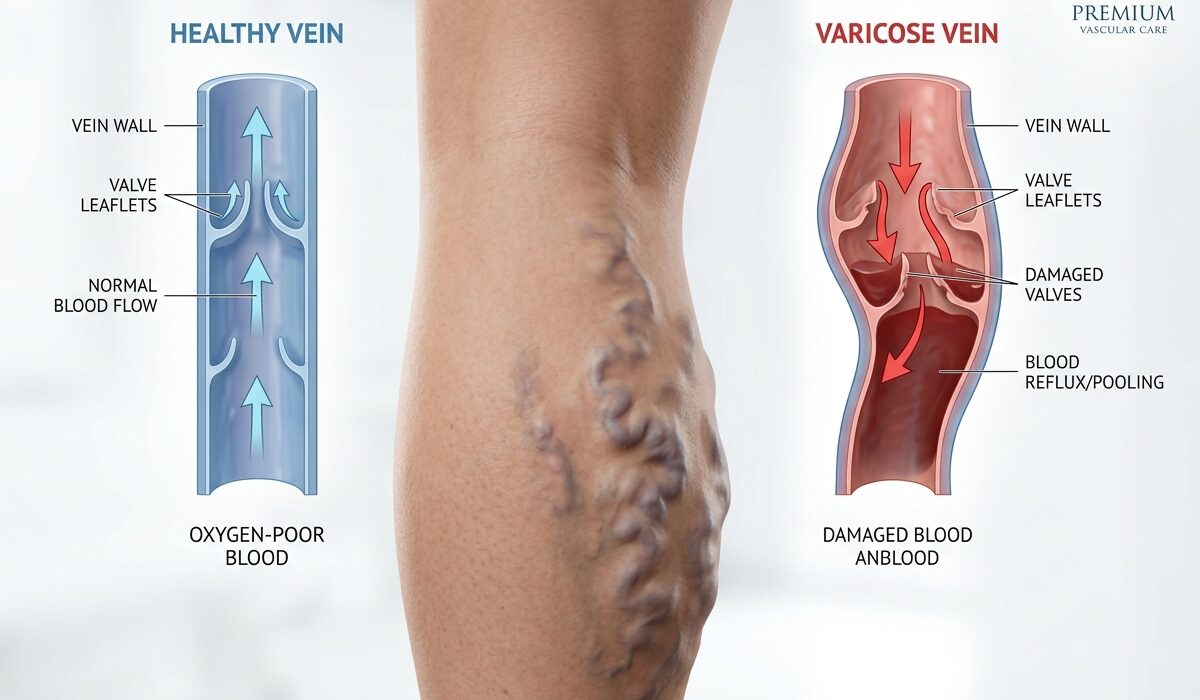
Your leg veins face an uphill battle—literally. Every heartbeat, they must push blood upward, against gravity, back toward your heart. To stop blood from sliding back down between beats, your veins are lined with small one-way valves that open to let blood through, then snap shut.
Varicose veins happen when those valves stop working properly. A weakened or damaged valve doesn’t close all the way. Blood leaks backward and pools in the section of vein below it. That pooled blood raises the pressure inside the vein wall—a process called venous reflux. Under this sustained pressure, the vein wall slowly stretches, thickens, and twists outward. Eventually, it becomes the bulging, discolored vein visible under the skin.
This is called chronic venous insufficiency at its earliest stage, and it is the true root cause of varicose veins. Not poor diet. Not a sedentary lifestyle alone. A mechanical failure in a tiny valve, made worse over time by the factors below.
The Risk Factors: Who is Most at Risk in Pakistan?
Varicose veins do not appear randomly. Certain factors make your valves vulnerable much earlier and the progression much faster. Some of these you cannot change. Several of you can.
Family history
If one parent had varicose veins, your risk roughly doubles. If both parents were affected, your lifetime risk approaches 90%. Inherited genes affect the quality of your vein wall and valve structure from birth.
Prolonged standing
Standing for six or more hours daily—as nurses, teachers, vendors, and factory workers do—eliminates the pumping action of calf muscles and keeps maximum gravitational pressure on leg veins all day.
Age (especially after 40)
Vein walls and valve leaflets lose elasticity naturally with age. The condition becomes significantly more common after 40 and accelerates through the 50s.
Excess body weight
Higher body weight raises pressure inside the abdomen and pelvis, directly squeezing the veins that drain blood from the legs. This makes every valve’s job harder.
Hormones:
Estrogen and progesterone both cause vein walls to relax and dilate. This is why women are twice as likely to develop varicose veins — and why oral contraceptives and hormone therapy increase risk further.
Practical Prevention Tips to Protect Your Veins
You cannot change your genetics or reverse a past pregnancy. But the right habits, started early, genuinely slow valve damage. Here are the six most evidence-backed steps:
Wear compression stockings on every long shift. Sigvaris 20–30 mmHg medical-grade stockings are the most effective single tool for standing workers. Put them on before your shift starts, not after your legs ache.
Walk for 5 minutes every 60–90 minutes. Static standing switches off your calf muscle pump. A short walk around the ward or classroom restores it. Set a phone reminder if needed.
Do low-impact exercise daily. Walking, swimming, and cycling activate venous return without raising abdominal pressure. Avoid heavy weightlifting without proper breathing technique.
Elevate your legs when resting. Prop them above heart level for 20 minutes at the end of the day. This lets gravity drain residual pressure from the lower leg veins passively.
Keep your weight in check. Even modest weight loss reduces pelvic and abdominal pressure on your venous drainage pathways significantly.
Taking the First Step: Moving from Prevention to True Vascular Care
If your veins already cause aching, swelling, or skin changes—or they have returned after a previous procedure—it is time to move beyond prevention into treatment.
Because the root cause is a failed valve, effective treatments close the dysfunctional vein rather than simply compressing it. At Vascular Care Lahore, we specialize in international gold-standard treatments that target the root of the problem without outdated surgical cuts.
Take Control of Your Vascular Health Today. Schedule a comprehensive duplex ultrasound mapping session with Dr. Usman Jamil Mughal at Horizon Hospital, Johar Town, Lahore. 📞 Call/WhatsApp: 0317-4123373